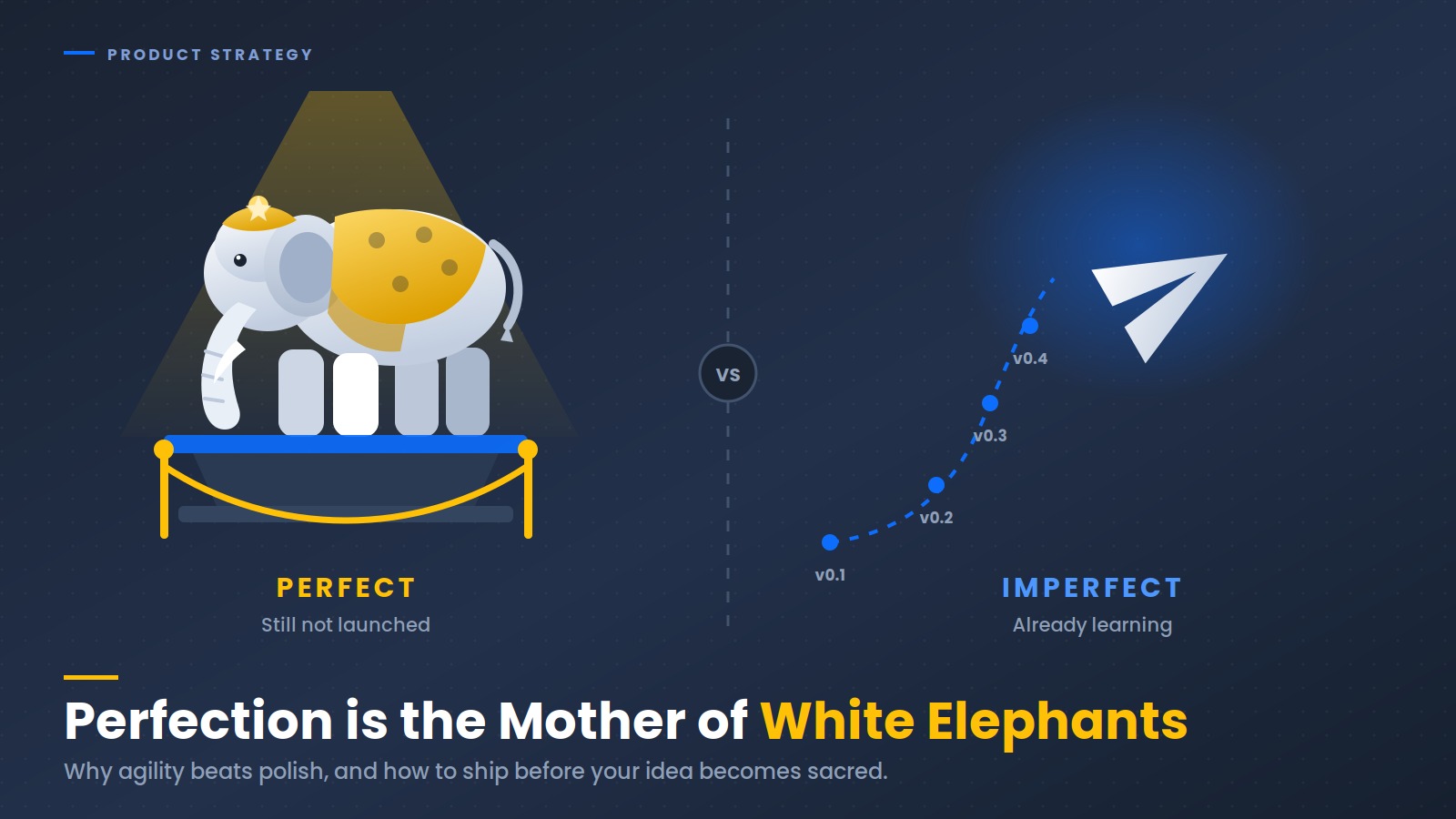
Somewhere on a hard drive, in a private repository, or in the back pages of a notebook, sits a brilliant idea that has never met a single customer. It is not there because it failed. It is there because it is not ready yet, and it has been not ready yet for two years running.
The phrase "white elephant" comes from the royal courts of old Siam. Rare albino elephants were considered sacred, so a king could destroy a troublesome courtier without lifting a sword: he simply gifted him one. The animal could not be put to work, because it was holy. It could not be sold or given away, because refusing or disposing of a royal gift was an insult. But it still had to be fed, housed, groomed, and guarded, every single day, forever. The gift was magnificent. It was also financially fatal.
That is exactly what happens to a good idea that is polished in private for too long. It becomes beautiful, impressive, technically immaculate, and completely unable to earn its keep. It consumes money, attention, and the founder's best years, and it returns nothing, because nobody outside the building has ever used it.
The Modern White Elephant
A project whose cost of upkeep, in money, time, morale, and opportunity, permanently exceeds the value it delivers. In business it usually looks like this: an over-specified product, built for an imagined user, launched late or never, and defended fiercely by the people who paid for it.
Every Giant Was Once an Embarrassment
We meet these companies at the end of their story, so we assume they were born impressive. They were not. Each of them shipped something small, awkward, and visibly incomplete, then let real users tell them what to build next.
Three platforms that would have failed a modern product review on launch day.
Facebook: a dorm-room directory with almost no features
When Thefacebook went live in February 2004, it was a simple profile directory restricted to one university. There were no photo albums, no News Feed, no Like button, no Messenger, no groups, no marketplace, no advertising, and no mobile app. Photos came a year later. The News Feed, the single feature that made the product addictive, only arrived in 2006, and users hated it so much at first that they organised protest groups on the very platform they were protesting against.
Even the mobile experience, now the entire business, was a false start. The early app was a thin web wrapper that performed badly, and the company eventually rebuilt it natively after admitting the approach was a mistake. Meta now reports roughly 3.6 billion daily active people across its family of apps in its 2026 quarterly results. It got there by being wrong in public, repeatedly, at speed.
Google: a research project with a page nobody designed
Google began in 1996 as BackRub, a Stanford research project running on borrowed and scavenged hardware. Its famously bare homepage was not a bold minimalist statement, it was a consequence of two engineers who did not have a designer and did not particularly enjoy writing HTML. The company incorporated in 1998 out of a rented garage, with no clear plan for making money. Advertising, the mechanism that now funds everything, came years after the product.
Alphabet's own filings show annual revenue passing $400 billion for the first time in 2025, and the company reported that its Gemini assistant had reached about 950 million monthly users by the middle of 2026. Note the pattern: the search engine shipped before the design, and the design shipped before the business model.
X: a two-week prototype from a company that was dying
Twitter was not even the main product. It was a side project inside Odeo, a podcasting startup whose business had just been flattened when Apple built podcasts into iTunes. The first version was assembled in roughly two weeks. Posts were capped at 140 characters purely because a text message is 160 characters and the username had to fit.
For years the service collapsed under its own popularity so often that its error page became an internet in-joke. Its most important conventions, the @reply, the hashtag, and the retweet, were invented by users and only later built into the product. A perfectionist team would have specified all of that in advance, badly, and shipped none of it. Twitter, now X, claims around 600 million monthly users, a figure independent analysts dispute, and it still sits near the centre of real-time news two decades later.
Every one of these products would have been killed in a modern boardroom for being incomplete. Incomplete is the point. Incomplete is how they found out what to complete.
How Perfection Quietly Builds Your White Elephant
Perfectionism rarely announces itself. It arrives wearing the uniform of professionalism. It sounds responsible. It sounds like quality control. Listen for these phrases, because each one adds another month of feeding an animal that cannot work.
"Let's just add one more feature before we launch." "We can't put that out with our name on it." "Let's wait until the rebrand is done." "I want it to be perfect for launch day." Each statement is defensible on its own. Stacked together over eighteen months, they produce a product built entirely on assumptions, because no assumption has ever been tested against a paying stranger.
The dotted line is the white elephant: maximum investment, minimum learning, one fragile moment of truth.
The trap is that both lines feel productive from the inside. The team polishing in private is busy, working long hours, and producing genuinely good work. The difference is that one team is accumulating knowledge about reality while the other is accumulating conviction about a guess.
The Real Cost of Waiting
A delayed launch does not just delay revenue. It compounds four separate losses at once.
You lose information. Every week your product sits unreleased is a week you learn nothing true about your market. You lose money twice. Once on the ongoing build, and once on the revenue you could have collected while iterating. You lose the window. Markets move, competitors ship, and platforms change their rules. You lose your nerve. The longer something stays unlaunched, the more terrifying launching becomes, because the perceived stakes grow with every hour invested.
That last one is the quiet killer. Perfectionism is not really about standards. It is usually about fear wearing a very respectable coat. A product that never launches can never be rejected, and for a lot of founders that is the actual, unspoken appeal.
Confidence Boosters: Getting Yourself to Actually Ship
Confidence is not something you find before you act. It is a by-product of acting. These are practical devices for lowering the height of the wall you are trying to jump.
Set the date before the scope.
Pick a launch date first, then ask what can honestly be built by then. Scope expands to fill available time, so refuse to give it any. A fixed date turns "what else could we add" into "what can we cut".
Ship to a small room first.
You do not need the whole market on day one. Ten users in a WhatsApp group, one client, one department, one street. A small audience gives you real feedback with a fraction of the exposure, which makes starting emotionally cheap.
Call it version 0.1, not a launch.
Language changes psychology. A "launch" implies finality and invites judgement. A "version" implies more are coming, which gives both you and your users permission to accept rough edges.
Define one metric that matters.
Before you build, decide the single number that will tell you if this is working: signups, repeat purchases, replies, bookings. Clarity about what counts removes the paralysing question of whether it is good enough, and replaces it with whether it moved the number.
Separate must-have from nice-to-have, ruthlessly.
Write both lists, then delete the second one from the plan entirely. If a feature does not block a customer from getting value today, it is not blocking your launch either.
Remember nobody is watching as closely as you think.
Your worst fear is a public flop. The realistic outcome of a modest launch is quiet indifference from most people and useful comments from a few. Obscurity is uncomfortable, but it is also a safety net for early mistakes.
Tell one person your date.
A deadline you have said out loud to someone who will ask about it is worth more than any productivity system. Borrow accountability if you cannot manufacture it alone.
Bank the small win, then stack it.
Confidence is built by evidence of your own follow-through. Ship something small this month, note that the sky stayed up, and the next launch costs you far less courage.
Failing Fast Without Falling Apart
"Fail fast" is repeated so often that it has lost its meaning. It does not mean fail carelessly, and it certainly does not mean fail expensively. It means arrange your work so that when you are wrong, you find out early, cheaply, and in a way you can act on. The failure is not the achievement. The speed and the low cost of the correction are.
Cap the loss before you start.
Decide in advance what you are willing to spend and how long you will run before you review. Pre-committed limits mean a failure costs you a defined amount rather than everything you have.
Write kill criteria while you are still calm.
"If we have fewer than 30 paying users by month three, we change direction." Deciding the exit conditions before you are emotionally invested is the only reliable way to make that decision well.
Separate the failed test from the failed person.
The experiment did not work. That is a fact about the market, not a verdict on your ability. Founders who conflate the two stop running experiments, which is the only truly fatal outcome.
Give yourself 48 hours, then debrief.
Feel the disappointment properly, it is real, then sit down and answer three questions in writing: what did we assume, what actually happened, and what would we do differently with the same money. Emotion first, analysis second, never both at once.
Salvage everything that still has value.
A failed venture leaves behind assets: code, designs, a mailing list, supplier relationships, a brand, and a great deal of hard-won market knowledge. Inventory them deliberately before you walk away, because most of it transfers to the next attempt.
Rebuild with a fast, visible win.
After a setback, do not immediately attempt something even bigger to prove yourself. Complete something small and public within weeks. Momentum is restored by finishing, not by scale.
Publish the lesson.
Writing honestly about what went wrong converts a private loss into public credibility. In most industries, the person who can explain exactly why an approach fails is trusted more than the person who has only ever described success.
Protect the ability to try again.
Never let one attempt consume the whole runway, the whole savings, or the whole relationship. The single greatest predictor of eventual success is simply still being in business to take the next swing.
Build It While It Runs
The companies at the top of this article did not win because their first versions were better than yours. Their first versions were worse. They won because they treated the product as a living system to be extended in public rather than a monument to be unveiled.
Agility is not an excuse for sloppiness. Nobody is suggesting you release something unsafe, dishonest, or broken. The distinction is between unfinished and unusable. Unfinished is a strategy. Unusable is a bug. Ship the smallest thing that genuinely helps somebody, charge for it if you can, then build the rest while it runs, guided by people who are actually using it.
The alternative is a magnificent, immaculate, sacred animal in your yard. It is beautiful. Everyone admires it. And it eats every day.
Ship it before it becomes sacred.
An imperfect product in the market will always teach you more, and cost you less, than a perfect one in your head. Pick your date, cut your scope, and let your first users finish the design.
Where the figures come from
1. Alphabet Inc., Q4 and full year 2025 results, filed with the US Securities and Exchange Commission. Annual revenue passing $400 billion for the first time. sec.gov
2. Alphabet Inc., Q2 2026 results, filed with the US Securities and Exchange Commission. Quarterly revenue of $119.8 billion. sec.gov
3. Roush, T., Forbes, 22 July 2026. Reporting Alphabet's disclosure of approximately 950 million monthly Gemini users. forbes.com
4. Social Media Today, 29 April 2026. Meta's Q1 2026 daily active people figure across its family of apps. socialmediatoday.com
5. Posterly, X platform guide, 2026. Compares Elon Musk's stated monthly user figure with lower independent app analytics estimates. poster.ly
Historical details about the launch of Thefacebook (2004), BackRub and Google's incorporation (1996 to 1998), and the origins of twttr inside Odeo (2006) are drawn from the widely documented public record of each company. All figures were current at the time of writing and should be refreshed if this piece is republished.